
How to Self-Publish a Nonfiction Book: The Complete Step-by-Step Guide for First-Time Authors
If you’ve been sitting on a book idea for months (or years), wondering how to actually get it out into the world, I want you to know something: you don’t need a publisher to make it happen. Learning how to self-publish a nonfiction book is more accessible than ever, and I’ve helped hundreds of first-time authors do exactly that over the past 17 years.
But here’s the thing. “Accessible” doesn’t mean “easy.” There are real steps you need to follow and real mistakes that can cost you time, money, and credibility. So let me walk you through the process I use with my own coaching clients, start to finish.
Why Self-Publishing Is the Best Path for Most Nonfiction Authors
Traditional publishing still has its place, but for most first-time nonfiction authors, self-publishing offers something traditional can’t: control.
You control your timeline. You control your pricing. You control your cover, your content, and your marketing. And with platforms like Amazon KDP, you can reach millions of readers without waiting 12 to 18 months for a publisher to say yes.
I’ve seen authors go from finished manuscript to published book in as little as 30 days when they follow a clear process. That’s the power of knowing how to self-publish a nonfiction book the right way.
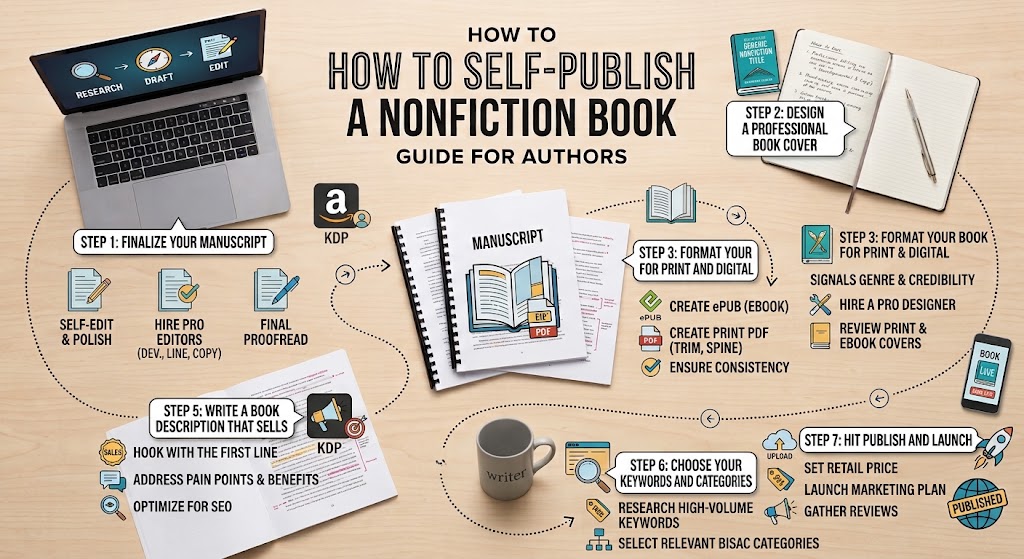
Step 1: Finalize Your Manuscript
Before you even think about uploading anything, your manuscript needs to be done. Not “almost done.” Not “I just need to tweak a few chapters.” Done.
That means:
- Your content is organized with a clear structure (introduction, chapters, conclusion)
- You’ve had at least one round of developmental editing to make sure the book actually works
- You’ve had a copy edit and proofread for grammar, spelling, and consistency
Skipping editing is the number one mistake I see first-time authors make. Your book is your business card. It represents you, your expertise, and your brand. Cutting corners here will show.
What About Developmental Editing?
Developmental editing looks at the big picture: your book’s structure, argument, flow, and whether it actually delivers on its promise to the reader. This is different from copy editing, which catches typos and grammar issues. Most first-time nonfiction authors need both, and developmental editing should come first. Learn more about my developmental editing services here.
Step 2: Design a Professional Book Cover
Your cover is your book’s first impression. Readers absolutely judge books by their covers, especially online where your cover is a tiny thumbnail competing with thousands of others.
Here’s what matters:
- Genre-appropriate design. Look at bestselling nonfiction books in your category on Amazon. What colors, fonts, and layouts do they use? Your cover should fit in while standing out.
- Readable title. If someone can’t read your title in thumbnail size, your cover isn’t working.
- Professional quality. This is not the place for DIY. Hire a cover designer. You can find good ones on platforms like 99designs or Reedsy for $300 to $500.
Step 3: Format Your Book for Print and Digital
Formatting is the step most authors dread, but it’s not as complicated as it sounds. You’ll need two versions:
- Ebook format (EPUB or MOBI for Kindle)
- Print format (a properly formatted PDF with correct trim size, margins, and page numbers)
Tools like Kindle Create (free from Amazon) or Vellum (Mac only, one-time purchase) make this much easier than doing it manually in Word. I walk my clients through this exact process, and most are surprised at how straightforward it is once you have the right tool.
Choosing Your Trim Size
For most nonfiction books, a 6″ x 9″ trim size works well. It’s the industry standard for self-help, how-to, and business books. If your book is more of a workbook or guide with exercises, consider 8.5″ x 11″.
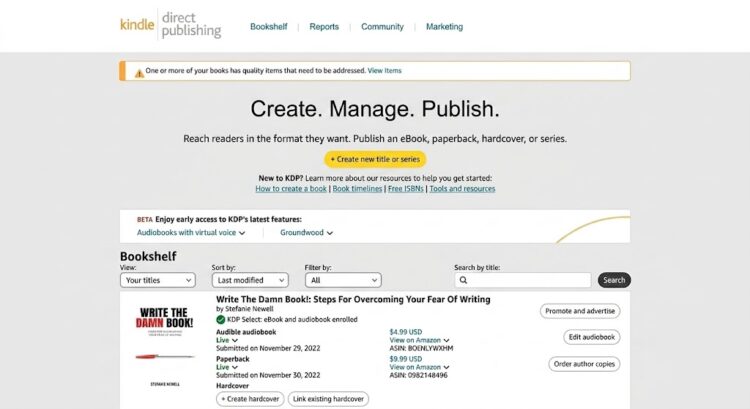
Step 4: Set Up Your Amazon KDP Account
Amazon KDP (Kindle Direct Publishing) is where most self-published nonfiction authors start, and for good reason. It gives you access to the world’s largest bookstore with no upfront costs.
Here’s what you’ll need to set up:
- KDP account (free to create at kdp.amazon.com)
- Your book details: title, subtitle, description, keywords, and categories
- Your ISBN. KDP offers a free ISBN, but I recommend purchasing your own through Bowker (myidentifiers.com) so you maintain full ownership. A single ISBN costs $125, or you can buy a pack of 10 for $295.
- Your pricing. For ebooks, pricing between $2.99 and $9.99 gives you a 70% royalty. For print, Amazon calculates a minimum price based on your page count and trim size.
For a detailed walkthrough of every field and setting in your KDP dashboard, see my Amazon KDP Publishing guide.
Step 5: Write a Book Description That Sells
Your Amazon book description is one of the most important pieces of marketing copy you’ll ever write. This is where browsers become buyers.
A strong nonfiction book description follows this structure:
- Hook. Open with the problem your reader is facing or the transformation your book delivers.
- Agitate. Show them you understand what they’re struggling with.
- Solution. Explain what they’ll learn and how the book will help.
- Proof. Mention your credentials or results your readers have gotten.
- Call to action. Tell them to buy it.
Keep it scannable. Use short paragraphs and bold key phrases. Amazon allows basic HTML formatting in descriptions, so take advantage of it.
Step 6: Choose Your Categories and Keywords
This is where most self-published authors leave money on the table. Your categories and keywords determine whether readers can actually find your book.
Categories: You get to choose two browse categories on Amazon. Pick categories that are specific enough that you can realistically rank, but broad enough to have real buyer traffic. Don’t pick “Nonfiction” as a category. That’s like opening a store and putting it in “Earth.” Go deeper: Self-Help > Personal Transformation > Self-Esteem, for example.
Keywords: You get seven keyword phrases (not single words). Think about what your ideal reader would type into Amazon’s search bar. “How to write a self-help book” is a keyword phrase. “Book” is not useful.
This is one area where professional help pays for itself. Amazon SEO can dramatically increase your book’s visibility if you get the keywords and categories right from day one.
Step 7: Publish and Review Your Listing
Once everything is uploaded, Amazon typically reviews and publishes your book within 24 to 72 hours. Use that time to:
- Double-check your book’s “Look Inside” preview once it goes live
- Verify your author page on Amazon Author Central
- Make sure your book description displays correctly
- Order a print proof to check for formatting issues
Step 8: Market Your Book
Publishing your book is not the finish line. It’s the starting line. Without marketing, even great books sit at zero sales.
Here’s a basic marketing plan for your first 30 days:
- Tell your email list. If you don’t have one, start building one now.
- Post on social media consistently. Not just “buy my book” posts, but content that shows your expertise on the topic.
- Reach out for reviews. Send advance copies to people in your network who would genuinely benefit from the book. Reviews are social proof, and they matter enormously on Amazon.
- Consider Amazon ads. Even a small daily budget ($5 to $10) can help your book show up in search results while you build organic momentum.
Marketing is where most authors feel overwhelmed, but it doesn’t have to be complicated. The key is consistency. I offer book marketing consultations if you want a personalized plan based on your book and your audience.
Common Mistakes to Avoid When Self-Publishing
After 17 years of coaching authors, I’ve seen the same mistakes come up again and again:
- Skipping professional editing. This is non-negotiable. Typos and structural problems will kill your credibility and your reviews.
- Designing your own cover. Unless you’re a professional graphic designer, hire someone. Your cover needs to compete with traditionally published books.
- Choosing the wrong categories. If you’re buried in a category with 50,000 other books, nobody will find you.
- Not building an email list. Social media followers are rented. Your email list is owned. Start collecting emails before your book launches.
- Giving up after launch week. Book sales are a marathon. The authors who succeed are the ones who keep marketing consistently for months after launch.
Want to stay organized through your entire self-publishing journey?
The Author’s Journal helps you track your progress from first draft to published book.
Get your copy here.
You Can Do This
Self-publishing a nonfiction book is one of the most rewarding things you can do as an expert, a coach, or someone with a story and knowledge to share. The process has real steps, but none of them are impossible. And you don’t have to figure it out alone.
If you’re working on a nonfiction book and want step-by-step guidance through the entire process, from writing to publishing to marketing, check out my coaching services or book a Pick My Brain session to get answers to your specific questions.
0 Comments