
Your nonfiction book could be the most useful, well-researched, genuinely life-changing thing on the shelf. But if your book description doesn’t stop someone mid-scroll on Amazon, none of that matters. Here’s the truth most first-time authors don’t hear until it’s too late: learning how to write a book description that sells is just as important as writing the book itself. Your description is the single most powerful piece of sales copy between a browser and a buyer. It’s the pitch. The handshake. The “here’s why this book is for you” moment.
And most nonfiction authors get it completely wrong.
Not because they’re bad writers. Because writing a book and writing sales copy are two entirely different skills. The good news? You don’t need to be a copywriter to write a strong book description. You just need a formula, a few principles, and the willingness to rewrite it until it works.
Let me walk you through exactly how to do that.
Why Your Book Description Matters More Than You Think
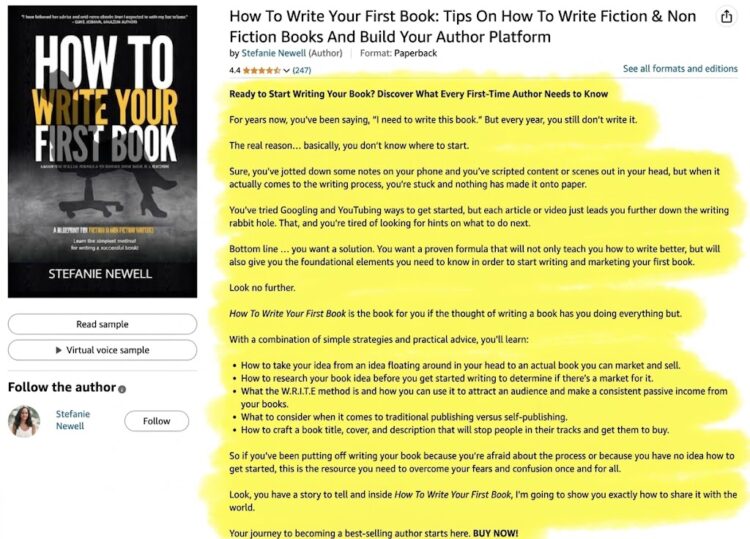
Think about the last time you bought a book online. You saw the cover, glanced at the title, and then what? You read the description. If it grabbed you, you scrolled down to check reviews. If it didn’t, you hit the back button.
That’s how your readers shop, too.
Your book description is doing three jobs at once:
- Convincing the right reader that this book is for them. Not every reader. Your reader.
- Giving Amazon’s search algorithm relevant keywords so your book shows up when people search for topics you cover.
- Overcoming the “I’ll think about it” impulse that kills sales for self-published authors.
A weak description doesn’t just lose one sale. It loses every sale from every person who lands on your page and doesn’t feel compelled to click “Buy Now.” And because Amazon’s algorithm factors in conversion rate (how many page visitors actually purchase), a poor description can push your book lower in search results over time.
So yes, this matters. A lot.
Reference: https://www.publishersweekly.com/pw/by-topic/industry-news/publisher-news/
The Biggest Mistake Nonfiction Authors Make With Their Book Description
Before we get into the formula, let’s talk about what not to do.
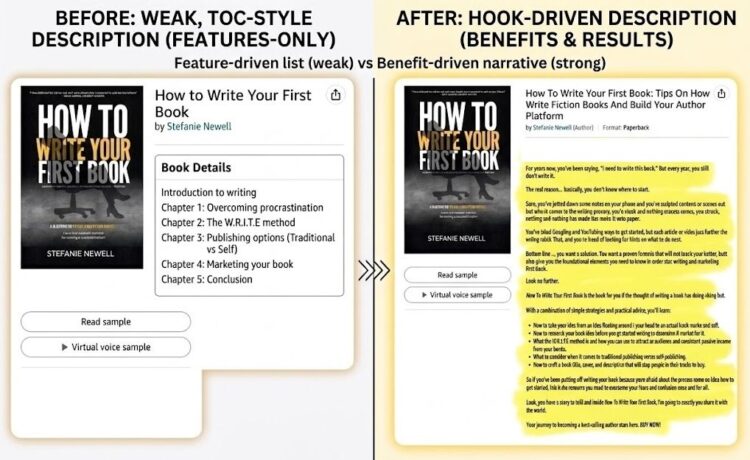
The most common mistake I see from first-time nonfiction authors? Writing a book description that reads like a table of contents.
It usually sounds something like this:
“In this book, you’ll learn about [topic]. Chapter 1 covers [thing]. Chapter 2 covers [thing]. Chapter 3 covers [thing]. This book is perfect for anyone interested in [topic].”
That’s not a description. That’s a syllabus. And nobody buys a syllabus.
Here’s why this approach fails: it tells the reader what’s in the book without telling them why they should care. There’s no emotional hook. No sense of what their life looks like after reading it. No urgency.
Your reader isn’t shopping for information. They can find information for free. They’re shopping for a transformation.Your description needs to sell the outcome, not the outline.
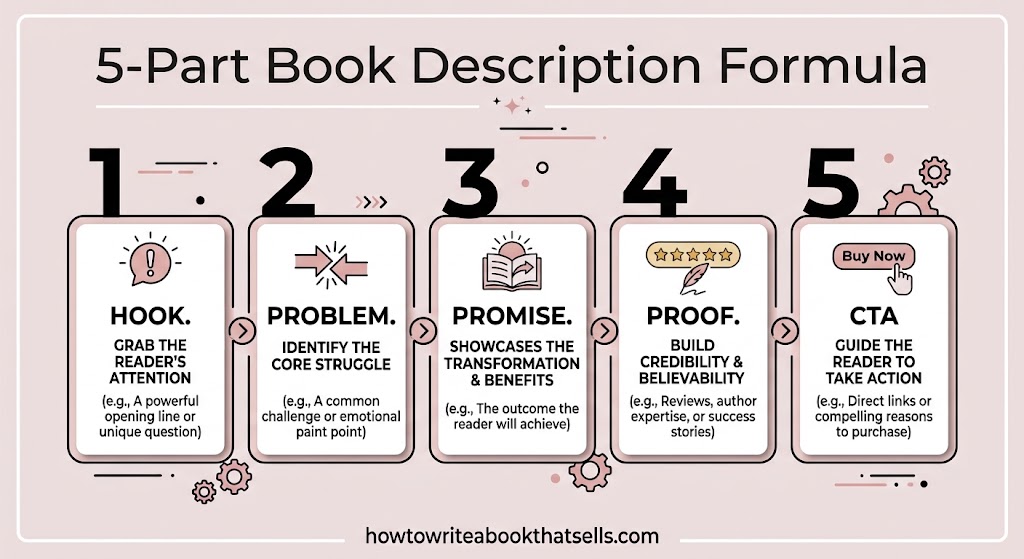
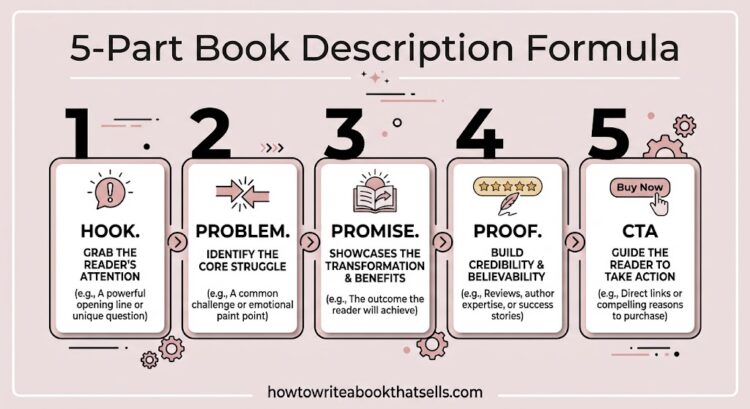
How to Write a Book Description That Sells: The 5-Part Formula
Here’s the formula I use with my coaching clients, and it’s the same one I’ve used for my own 15+ published books. It works for nonfiction across the board: self-help, memoir, business, how-to, personal development, and everything in between.
Part 1: The Hook (First 1-2 Sentences)
Your hook has one job: stop the scroll. It needs to hit the reader in a place they recognize. A frustration. A desire. A question that’s been nagging them.
Strong hooks for nonfiction usually fall into three categories:
- The problem statement. “You’ve been sitting on your book idea for months, but every time you sit down to write, you freeze.”
- The bold claim. “Most first-time authors waste thousands of dollars on publishing mistakes that are completely avoidable.”
- The empathy opener. “If you’ve ever felt like everyone else knows how to get published except you, you’re not alone.”
Notice what all three do: they name a feeling the reader already has. That’s the secret. You’re not creating desire. You’re reflecting it back to them.
Part 2: The Problem (2-3 Sentences)
After the hook, go deeper into the problem. This is where you show the reader you understand their situation better than they do.
Don’t be vague. Be specific. Name the exact frustrations, fears, or confusion your reader deals with. The more specific you are, the more they think, “This person gets it.”
Example:
“You’ve Googled ‘how to write a book’ so many times the results are starting to repeat. You’ve downloaded free guides that gave you generic advice. Maybe you even started writing, got to chapter three, and stopped because you weren’t sure if any of it was good enough.”
That specificity is what builds trust before someone has read a single page of your book.
Part 3: The Promise (2-3 Sentences)
Now pivot. This is where you introduce your book as the solution.
Don’t just say “this book will help you.” Tell them specifically what changes for them. Paint the after picture.
Example:
“This step-by-step guide walks you through the entire process, from choosing your topic and building your outline to writing your final chapter and preparing your manuscript for publication. No fluff. No filler. Just a clear path from blank page to finished book.”
Notice how this isn’t a list of chapters. It’s a promise of a journey with a clear destination.
Part 4: The Proof (2-3 Sentences)
Why should the reader trust you? This is where your credibility comes in. For nonfiction, proof usually looks like:
- Experience. “Written by a writing coach with 17 years of experience and 15+ published books.”
- Results. “Clients have used this process to hit #1 in their Amazon category on launch day.”
- Specificity. “Based on lessons learned publishing across Amazon, IngramSpark, and Barnes & Noble.”
You don’t need to write a full bio here. One or two sentences that establish why you’re the person to write this book. That’s it.
Part 5: The Call to Action (1-2 Sentences)
End with a clear, direct nudge. Tell the reader exactly what to do next.
“Scroll up and click ‘Buy Now'” is the classic Amazon CTA, and it works because it’s specific and action-oriented. You can also use:
- “Start reading today and take the first step toward your published book.”
- “Your book idea deserves better than a drawer. Grab your copy now.”
- “If you’re serious about writing your first book, this is where you start.”
Don’t overthink this. The CTA is the nudge, not the argument. The argument already happened in parts 1 through 4.
How to Write a Book Description for Amazon Specifically
Amazon gives you up to 4,000 characters for your book description, but most of it gets hidden behind a “Read more” fold. That means only your first 2-3 sentences are visible without clicking. Everything above the fold has to earn the click.
Here are a few Amazon-specific tips for making your book description work harder:
Use HTML formatting. Amazon allows basic HTML in your book description: bold text (<b>), italic text (<i>), and line breaks (<br>). Use bold to highlight key phrases and benefits. Use line breaks to create visual breathing room. A wall of text gets skipped.
Front-load your keywords. If your target readers are searching for “self-publishing guide for beginners” or “how to write a nonfiction book,” those phrases should appear naturally in your first few sentences. This helps Amazon’s A9 search algorithm connect your book to the right queries. (For a deeper look at keywords, categories, and metadata, check out my Amazon SEO service for authors.)
Write for skimmers. Most Amazon shoppers don’t read every word. They scan. Use short paragraphs, bold key phrases, and bullet points for “what you’ll learn” lists. Make it easy for someone spending 10 seconds on your page to get the gist.
Don’t waste space on generic praise. “A must-read!” and “This book is amazing!” mean nothing without context. If you include a blurb or endorsement, make it specific: “This book gave me the exact framework I needed to go from idea to published in under a year.”
A Quick Checklist Before You Publish Your Description
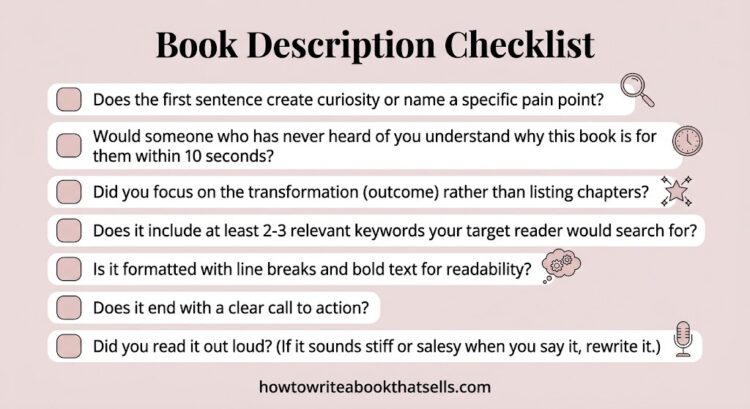
Before you finalize your book description, run through this list:
- Does the first sentence create curiosity or name a specific pain point?
- Would someone who has never heard of you understand why this book is for them within 10 seconds?
- Did you focus on the transformation (outcome) rather than listing chapters?
- Does it include at least 2-3 relevant keywords your target reader would search for?
- Is it formatted with line breaks and bold text for readability?
- Does it end with a clear call to action?
- Did you read it out loud? (If it sounds stiff or salesy when you say it, rewrite it.)
If you checked every box, you’re in good shape. If not, go back to the formula and rework the sections that feel weak.
What to Do If Your Current Description Isn’t Working
If your book is already published and your description isn’t converting, don’t panic. You can change your Amazon book description at any time through your KDP dashboard. There’s no penalty for updating it, and many successful authors revise their descriptions multiple times.
Here’s how to diagnose the problem:
Check your click-through rate. If people are finding your book in search results but not clicking through, the issue is likely your title, subtitle, or cover, not the description. The description only comes into play once someone lands on your book page.
Check your conversion rate. If people are landing on your page but not buying, the description is your prime suspect. Your page views are high but your sales are low? Rewrite the description using the formula above.
A/B test if possible. Change one element at a time. Try a new hook for two weeks and track whether sales change. Then try a new CTA. Small, measured changes tell you what’s working better than a complete overhaul.
And if you want a professional eye on your description, that’s exactly what my Book Description Review service is for. I’ll tell you what’s working, what’s not, and give you specific rewrites to improve your conversion.
Your Book Description Is Your Best Salesperson
Here’s what I want you to walk away with: your book description isn’t an afterthought. It’s not the boring administrative thing you fill in right before you hit “Publish” on KDP. It is the most important piece of marketing copy your book will ever have.
It works 24 hours a day. It never takes a day off. Every single person who considers buying your book will read it. And it either convinces them or it doesn’t.
So give it the time and attention it deserves. Use the 5-part formula. Write it, rewrite it, read it out loud, and rewrite it again. Your book worked too hard to get written for a weak description to be the reason it doesn’t sell.
Know Your Reader Before You Write a Single Word
The foundation of a great book description is knowing exactly who you’re writing it for. If you’re not clear on your target audience, every sentence in your description is a guess.
I created a free resource to help you get that clarity before you start writing your description (or your book, for that matter). 5 Mistakes Writers Make With Target Audience breaks down the most common missteps authors make when defining their ideal reader, so you can avoid them and write with confidence.
👉🏾 [Download “5 Mistakes Writers Make With Target Audience”]
Once you know who you’re talking to, writing a description that resonates with them becomes a whole lot easier.
Now I’d love to hear from you: What’s the hardest part of writing your book description? Is it the hook, the CTA, or just figuring out what to say? Drop a comment below.
0 Comments