


You have something to say. Maybe it’s expertise you’ve built over decades, lessons from a life-changing experience, or a process you’ve refined that genuinely helps people. And you keep thinking: I should write a book about this.
You should. But figuring out how to write a nonfiction book when you’ve never done it before? That’s where most people get stuck.
I’ve been there. I published my first nonfiction book over 17 years ago, and since then I’ve written 15+ books and coached hundreds of first-time authors through this exact process. The biggest thing I’ve learned is this: writing a nonfiction book isn’t about talent. It’s about following a clear process, step by step. That’s what this guide gives you.
Step 1: Pick a Topic That Solves a Real Problem
Before you write a single word, you need clarity on what your book is actually about and who it’s for.
The best nonfiction books don’t try to cover everything. They solve one specific problem for one specific reader. Think about the questions people ask you all the time. The advice you find yourself repeating. The gap you see in the books that already exist on your subject.
Ask yourself three questions:
- What do I know that other people need to learn?
- Who is the person I’m writing this for? (Be specific. “Everyone” is not an audience.)
- What transformation does the reader get by the last page?
If you can answer those three clearly, you have a book worth writing. If the answers feel fuzzy, spend time here before moving forward. A blurry topic leads to a blurry book, and blurry books don’t sell.
Pro tip: Browse Amazon’s nonfiction bestseller lists in your category. Read the 1-star and 3-star reviews. Readers will tell you exactly what’s missing from the books that already exist. Your book can fill that gap.
Step 2: Create Your Outline Before You Write Anything Else
I cannot overstate this: an outline is the single most important step in learning how to write a nonfiction book. It’s the difference between sitting down knowing exactly what to write and staring at a blank page wondering where to start.
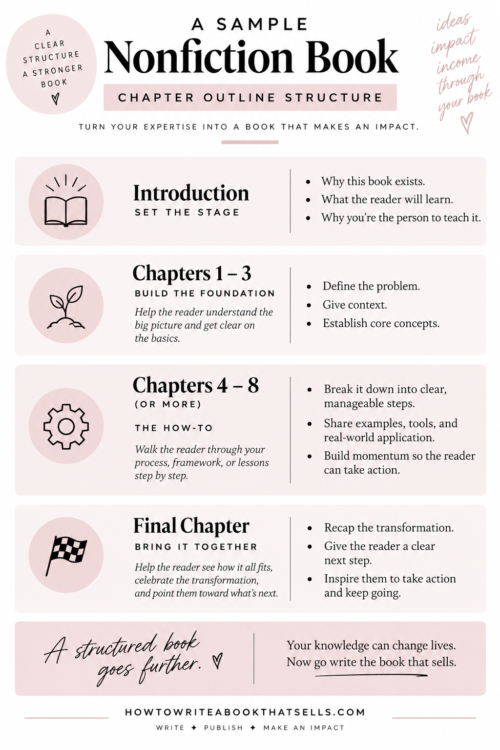
Your outline doesn’t need to be fancy. Here’s a simple framework that works for most nonfiction books:
- Introduction: Why this book exists. What the reader will learn. Why you’re the person to teach it.
- Chapters 1 through 3: Build the foundation. Define the problem, give context, establish core concepts.
- Chapters 4 through 8 (or more): The how-to. Walk the reader through your process, framework, or lessons step by step.
- Final chapter: Bring it together. Recap the transformation, give the reader a clear next step.
Each chapter should have a single main idea. If a chapter is trying to say two things, it’s two chapters.
Write your chapter titles first, then add 3 to 5 bullet points under each one describing what you’ll cover. That’s your roadmap. When you sit down to write, you’ll know exactly where you’re going.
If you want a ready-made structure to follow, my Manuscript Format/Outline Templates give you the exact framework I use with my coaching clients so you don’t have to build one from scratch.
Step 3: Set a Writing Schedule You’ll Actually Keep
Here’s where most aspiring authors fall off. They get excited, write 3,000 words in one sitting, and then don’t touch the manuscript for two weeks. That cycle kills books.
Consistency beats intensity every time. Decide how many days per week you’ll write and how long each session will be. Then protect that time like it’s a meeting you can’t cancel.
Some guidelines that work for most first-time nonfiction authors:
- Write 4 to 5 days per week. Not 7. You need rest days to let ideas breathe.
- Target 500 to 1,000 words per session. That’s roughly 30 to 60 minutes of focused writing.
- At that pace, a 40,000-word manuscript takes about 2 to 4 months of consistent drafting. (A typical nonfiction book runs 30,000 to 60,000 words, depending on the subject.)
The goal isn’t to write perfectly. It’s to write consistently. Your first draft does not need to be good. It needs to exist.
Step 4: Write the First Draft (And Don’t Edit While You Write)
This is the step that separates authors who finish from authors who don’t: write your first draft all the way through before you go back and revise anything.
I know it’s tempting to reread what you wrote yesterday and start fixing sentences. But editing while you draft is the fastest way to get stuck. You end up rewriting Chapter 1 six times while Chapters 5 through 10 never get written.
Here’s how to push through:
- Follow your outline. You already know what each chapter needs to say. Write it.
- Write like you’re talking to your reader. Nonfiction doesn’t need to sound academic. The best nonfiction books read like a smart conversation between friends. Imagine your ideal reader sitting across from you. What would you tell them?
- Leave brackets for things you’ll fix later. Don’t stop your momentum to Google a statistic or find the perfect word. Write [INSERT STAT HERE] and keep going.
- Celebrate finishing each chapter. Seriously. A finished rough chapter is worth more than a polished paragraph.

According to the Alliance of Independent Authors, one of the most common reasons manuscripts stall is the author’s inability to separate the drafting process from the editing process. They’re two different skills that use two different parts of your brain. Draft first. Edit later.
Step 5: Revise (The Right Way)
Once your first draft is done, take a break. Seriously. Step away for at least a week before you start revising. You need distance to see your work clearly.
When you come back, read the full manuscript in one or two sittings. Don’t fix anything yet. Just read. Make notes in the margins. You’re looking for:
- Gaps: Places where a reader would think, “Wait, how do I actually do that?”
- Repetition: Chapters or sections that say the same thing in different words.
- Flow: Does the book build logically? Could a reader follow this from start to finish without getting confused?
- Promise delivery: Does your book actually deliver what you promised in the introduction?
This is developmental-level revision, the big-picture edit. It’s far more important than fixing commas. If the structure of your book doesn’t work, perfect grammar won’t save it.
This is also the stage where working with a developmental editor can make a dramatic difference, especially for first-time authors. A developmental editor reads your manuscript and gives you honest, detailed feedback on structure, clarity, argument, and reader experience. Authors at any stage of their manuscript can benefit from this, not just those with a finished draft. If you’re partway through and unsure whether your manuscript is headed in the right direction, developmental editing can help you course-correct before you invest more months writing in the wrong direction.
After the structural revision, then come the smaller passes: tightening sentences, checking facts, fixing grammar. Most nonfiction books need two to three rounds of revision before they’re truly ready.
Step 6: Decide How You’ll Publish
Once your manuscript is polished, you’ve reached the fork in the road: traditional publishing or self-publishing?
For most first-time nonfiction authors, self-publishing is the faster, more flexible, and more profitable path. You keep creative control, set your own timeline, and earn higher royalties per book. Traditional publishing still makes sense for some authors, but it typically requires an agent, a proposal, and 12 to 18 months of waiting before your book even goes to print.
I walk my clients through both options so they can make the right choice for their goals.
If self-publishing is the direction you’re leaning, I put together a complete step-by-step guide to self-publishing a nonfiction book that covers everything from formatting and cover design to Amazon KDP setup and marketing.
Step 7: Don’t Skip the Marketing
I know. You just want to write the book. But here’s a truth most first-time authors learn the hard way: a great book with no marketing plan sells zero copies.
You don’t need a massive following or an ad budget to market a nonfiction book. You need a plan. At minimum, think about these pieces while you’re still writing:
- Build an email list. Even a small one. These are your future readers and launch team.
- Start showing up online around your book’s topic. Write about it, talk about it, teach what you know. This builds an audience before launch day.
- Plan your launch week. Know exactly when and how you’ll announce the book, where you’ll promote it, and who you’ll ask for support.
The Authors Guild reports that author incomes have been declining, and the authors who buck that trend are the ones who actively market their work rather than relying on a platform to do it for them. Your book is a business. Treat the marketing like it matters, because it does.
The Whole Process at a Glance
Here’s how to write a nonfiction book, start to finish:
- Pick a topic that solves a real problem for a specific reader.
- Create a detailed outline before writing a word.
- Set a consistent writing schedule and stick to it.
- Write the first draft without editing as you go.
- Revise structurally first, then at the sentence level.
- Choose your publishing path (for most first-time authors, self-publishing wins).
- Market the book before, during, and after launch.
It’s a clear process. Not always easy, but absolutely doable when you follow it step by step.
You Don’t Have to Figure It Out Alone
If you’re at the beginning of this journey and you want a guide who’s done it before, that’s exactly what I do.
I’ve spent 17+ years helping first-time nonfiction authors go from idea to published book. Whether you need help with your outline, feedback on your manuscript, or a full coaching partnership, I’m here for that.
👉🏾 Explore my coaching services to see how we can work together.
Grab the Author Checklist
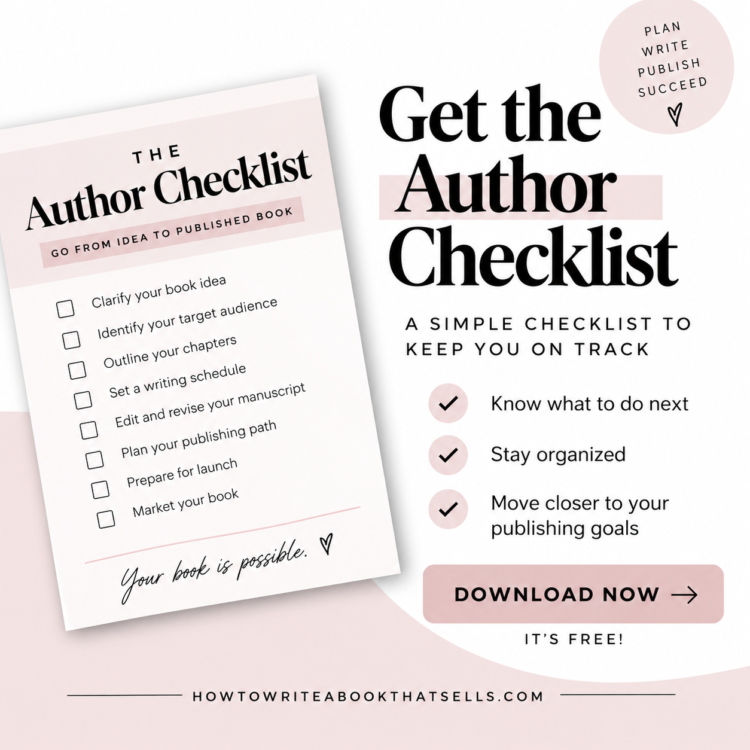
Before you start writing, make sure you have the essentials covered. My Author Checklist walks you through every step you need to complete before, during, and after writing your nonfiction book so nothing falls through the cracks.
👉🏾 Download the free Author Checklist here
Your Turn
What’s the biggest thing holding you back from starting your nonfiction book? Is it figuring out the topic, finding time to write, or something else entirely? Drop a comment below. I read every one and I’d love to help you get unstuck.
0 Comments